What Certifications Should Liposomal Curcumin Powder Have?
2026-05-15 16:18:36
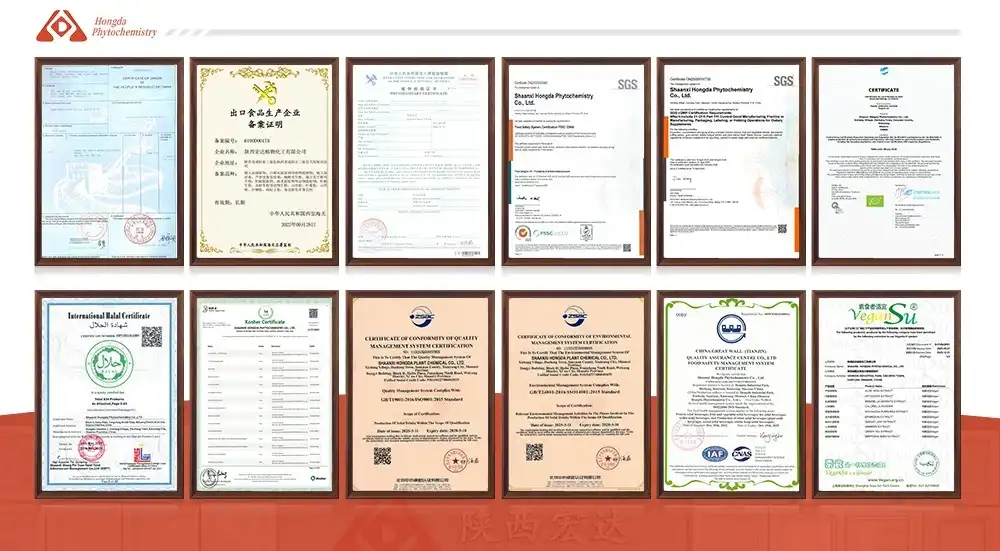
When looking for advanced curcumin formulations, certificates are the best way to protect yourself from inconsistent quality and legal noncompliance. Liposomal curcumin powder should have important Certifications, such as cGMP for honest manufacturing, ISO 9001 and ISO 22000 for quality management and food safety, HALAL and KOSHER for dietary compliance, FSSC 22000 for full food safety systems, and organic certifications if the company says the powder comes from natural sources. These qualifications prove that the ingredients are pure, can be tracked, and meet production standards. These are important differences between pharmaceutical-grade ingredients and cheaper options used in cosmetics and nutraceuticals.
Understanding the Importance of Certifications in Liposomal Curcumin Powder
Why Certifications Matter Beyond Paperwork
Certifications of quality serve as standard ways for buyers and sellers who work in different legal areas to talk to each other. Certifications show that makers have the right technical infrastructure, quality control methods, and process documentation to make sure consistent output when working with complex delivery systems like liposomal encapsulation. The nutraceutical business has to deal with problems like adulteration, contamination, and standards that aren't clear. Third-party certifications add layers of independent proof that level the playing field of information. This is especially helpful when buying from international sources where physical checks are expensive and take a lot of time.
Common Misconceptions That Cost Money
A lot of people who work in buying are wrong when they say that a single license guarantees quality in every way. The truth is more complicated. cGMP approval verifies the way products are made, but it doesn't promise that organic ingredients will be used. In the same way, organic approval verifies farming methods but not the cleanliness of production facilities or the rules for avoiding cross-contamination. Another common mistake is mixing up facility approval with product testing. COA papers confirm the specifics of each batch, and building certifications such as ISO 22000 confirm that food safety is managed systematically throughout all production activities. In complete quality assurance systems, both parts do different things.
The Real Cost of Uncertified Suppliers
Problems with quality that cause problems in the supply chain cost a lot more than the difference in price between recognized and uncertified providers. Product recalls can ruin years of work to build a business in just a few days. Regulatory delay at customs causes stock shortages that spread through networks of delivery. In addition to losing money, using uncertified Liposomal Curcumin Powder puts consumers' health at risk, which can lead to lawsuits and damage to the company's image that cannot be fixed.
Key Certifications Every Liposomal Curcumin Powder Supplier Should HaveGood Manufacturing Practice (cGMP) Compliance
cGMP approval is the most important badge for any serious seller of nutraceutical ingredients. These rules set base standards for buildings, tools, training for workers, and ways to check the quality of the work. Our cGMP-certified production center at Hongda is constantly watched over by routines that record every important control point, from receiving raw materials to Packaging them up at the end. The pharmaceutical-grade standard calls for packaging efficiency of more than 90%, which can only be reached with precise tools and tried-and-true methods. Our 100,000-level cleaning workshop maintains a contamination-free environment that is essential for producing nanoparticles in the 100 nm to 200 nm range. Without a cGMP infrastructure, it is almost impossible to get a uniform spread of particle sizes in liposomal curcumin powder.
ISO Standards That Signal Operational Excellence
ISO 9001 approval backs up systematic methods to quality management that go beyond product standards and include how a company works. This standard makes sure that sellers keep written records of how they handle non-conformances, take corrective steps, and work toward ongoing growth. These are skills that have a direct effect on the reliability of the supply chain. Food safety management systems are especially talked about in ISO 22000, which combines HACCP concepts with prerequisite programs. This approval is especially useful for curcumin mixtures that will be used in functional foods and drinks, where allergen controls and tracking standards become stricter. The ISO 22000 certification for our plant gives purchasing managers written proof that food safety risks are identified and reduced in a planned way during all production processes.
Organic Certifications for Putting on a Clean Label
Market study shows that people regularly want organic-certified products, especially in high-end supplement areas. Organic approval makes sure that the raw materials, in this case both curcuminoids and phospholipids, come from farming methods that don't use synthetic chemicals, GMOs, or other substances that are not allowed. In order to get certified, there has to be careful recording of the supply chain, from growing the plants on farms to extracting them and putting them in capsules. We only use non-GMO sunflower lecithin to meet organic standards and escape the allergen problems that come with phospholipids that come from soy. By paying close attention to where the ingredients come from, our clients can get the higher prices that come with having a clean name.
Third-Party Verification Credentials
While producer certifications verify internal systems, third-party testing qualifications from groups such as SGS give a second opinion on the product's specs. Our SGS-certified lab does dynamic light scattering research on every production batch to check the particle size distribution and encapsulation efficiency measures that show how well the liposomal formulation works. There is a basic lack of trust in B2B ingredient deals that these external verification protocols try to fix. When sellers test their own goods, there may be conflicts of interest that make the results less reliable. This worry is taken away by independent laboratory approval, which gives purchasing managers fair information to help them decide which suppliers to work with.
Regulatory Compliance Certifications for Global Markets
FDA Registration and U.S. Market Access
The FDA doesn't officially "approve" dietary supplement products, but following FDA rules and registering a location are signs that a company is allowed to be in the market. Facilities that are FDA-registered follow strict checking routines and keep up-to-date systems that make sure the identity, purity, strength, and composition of ingredients match what is said on the label. Every year, the rules get stricter, and the FDA is paying more attention to how nanomaterials can be used in vitamins. When it comes to safety paperwork and factory rules, liposomal curcumin powder formulations with particles smaller than 200 nm are looked at more closely. Proactively placing a liposomal curcumin powder supplier to comply with FDA rules lowers the regulatory risk that purchasing managers face.
FSSC 22000 and AFS Systems for Full Food Safety
The Global Food Safety Initiative recognizes FSSC 22000 certification as a system that combines ISO 22000 standards with other prerequisite programs that are specific to the food production industry. When selling ingredients to international companies with complicated global supply lines and standard seller requirements, this certification is very important. The plan calls for a thorough risk assessment that looks at biological, chemical, and physical pollution threats. Hongda's FSSC 22000 approval shows that we have strict controls in place to deal with any risks that might come up during the plant extraction and liposomal encapsulation processes. For example, we check raw turmeric for mycotoxins and make sure that there is no cross-contamination during spray-drying.
HALAL and KOSHER Certifications for Market Expansion
Religious food approvals give you access to large groups of people who are likely to be interested in your product. HALAL approval proves that a product follows Islamic dietary law, which is important for getting into markets in the Middle East, Southeast Asia, and Western countries with Muslim populations. In the same way, KOSHER approval opens doors in Jewish groups and appeals to customers who see kosher standards as a sign of better quality control. For both certificates, production methods, ingredient sources, and building sanitation must be constantly supervised by a rabbinical or Islamic authority. Hongda is committed to making markets accessible to everyone, and our dual HALAL and KOSHER standards show that. This means that clients can make goods for a wide range of customers without having to change the ingredients.
How Certifications Influence Liposomal Curcumin Powder Procurement Decisions
Aligning Certifications with Procurement Objectives
Making strategic buying choices means balancing a lot of different needs, such as lowering costs, making sure supplies are safe, making sure quality is high, and following all the rules. Certifications provide clear evaluation factors that make the process of choosing a seller less dependent on personal opinion. When reviewing quotes, certified providers show that their higher prices are worth it by reducing risk and maintaining quality. Purchasing managers are adding seller certifications to weighted scorecards more and more. These scorecards measure intangible factors like trust and compliance stance. Supply chain vulnerability reviews are made more difficult when a seller group doesn't have the right certifications. As regulatory regulations get stricter around the world, these secret risks turn into real problems that stop operations for liposomal curcumin powder buyers.
Balancing Cost Considerations with Long-Term Value
Prices for certified ingredient sellers are usually 15–30% higher than prices for options that aren't certified. This is because keeping compliance infrastructure costs more. Quality control labs, paperwork systems, external checks, and specialized tools all need long-term investments that suppliers of goods don't want to make. The total cost of ownership, not just the unit price, should be used to compare this price difference. Certified sellers show lower failure rates, which lowers the costs of rejecting batches, reworking recipes, and launching products later than planned. Problems with quality that cause problems in the supply chain can easily cost more each year than the money saved by finding cheaper choices. Over longer periods of time, approved sellers provide better value by being consistent and dependable.
Best Practices for Verification
Reviewing documents is the first step in making sure something is true, but it shouldn't be the only thing you do as part of your due diligence. Instead of depending on copies given by the supplier, ask the issuing body for up-to-date certification papers directly. Independent proof of current certification status is possible through records kept up to date by ISO registrars, organic certification bodies, and religious authorities. You might want to use skilled third-party inspection services to do regular checks of your suppliers. Virtual exams using video recording are becoming more and more common as an option to in-person visits. They save money while still being reliable. Customer audits are welcome at our site because they give us a chance to show off our operational skills and build long-lasting relationships based on trust.
Emerging Certification Trends and Their Future Impact on Liposomal Curcumin Powder BuyersDigital Verification and Blockchain Integration
In traditional certification methods, compliance is checked at regular intervals through exams. New digital verification tools let IoT sensor networks and blockchain-recorded transactions be used for constant monitoring. These technologies claim to let you see production factors, where ingredients come from, and quality control results in real time. Early users of blockchain-based traceability systems have shown that they can better meet the needs of regulators and customers for more openness. We think that digital certificates will be the norm within five years, especially for high-end nutraceutical products, where Liposomal Curcumin Powder buyers care a lot about validity.
Sustainability and Environmental Certifications
When it comes to ingredient certificates, carbon impact exposure, and environmental management certifications are the ones that are growing the fastest. Customers further down the supply chain are putting more and more pressure on B2B buyers to keep records of their sustainable buying practices. Certifications that cover things like using green energy, water efficiently, and cutting down on waste give us a standard way to compare environmental performance. When sustainability and quality standards come together, they build unique market situations. Suppliers who can produce pharmaceutical-grade goods and care for the environment are in line with changing corporate social responsibility goals that affect buying choices in ways other than just price and quality.
Certifications for Nanomaterials
As government agencies create unique rules for nano-scale ingredients, you can expect certificates that focus on liposomal and nanoparticle formulas to appear. These qualifications may prove methods for characterizing particles, checking for toxicology, and handling nanomaterials in a certain way. Suppliers who start following new rules for nanomaterials early will have a competitive edge as the rules become clear.
Conclusion
To find your way around the certification world, you have to find a balance between broad coverage and real buying limitations. Some of the most important certifications are cGMP for making sure the quality of the product is high; ISO standards for managing quality and food safety; organic certificates for using clean labels; and religious dietary certifications for getting into the market. Regulatory licenses and third-party checks finish off the system that helps people choose suppliers based on accurate information. It's been our observation that procurement pros who get the best results see certifications as living tools rather than fixed boxes. Supply chain robustness is maintained by regularly reviewing certification standards in light of changing market conditions and regulations. As liposomal delivery technologies improve and governmental oversight grows, certification standards will also change. This means that ongoing contact and partnerships with suppliers are key parts of effective procurement strategies for liposomal curcumin powder.
FAQWhich certification carries the most importance for liposomal curcumin formulations?
The most important credential is cGMP approval, which verifies the production infrastructure and process controls needed to make consistent nanoscale liposomal particles. It's not possible to meet the 80–90% packaging efficiency standards without using the right GMP methods. For food-grade uses, ISO 22000 comes in close second, while organic approval is more important for going after premium clean-label markets.
How can we verify certification authenticity?
Instead of depending on contact information given by the supplier, get in touch with certification groups directly using information from their websites. Most certification bodies keep public records that can be searched by company name or certificate number. Ask for full copies of the certificates that show the scope, expiry dates, and signatures of the granting authority. Watch out for certificates that aren't clear, don't say what they cover, or were given by organizations you don't know.
Do certifications guarantee product efficacy?
Certifications check that the production process, the quality of the ingredients, and the safety rules are followed. However, they don't directly prove therapeutic effectiveness or bioavailability performance. How well something works depends on how it was made and how bioactive the active ingredients are. However, certificates guarantee that the production controls always produce the particle size, encapsulation efficiency, and curcuminoid concentration standards that make the formulation bioavailable in the way that it's supposed to be. Clinical testing is the only way to be sure that a drug works.
Partner with Hongda for Certified Excellence in Liposomal Curcumin Supply
Hongda Phytochemistry has been extracting plants for more than twenty years and now uses that knowledge to make advanced liposomal delivery systems. As a qualified producer of liposomal curcumin powder with cGMP facilities, ISO 9001/22000 quality systems, and full HALAL, KOSHER, FSSC, and organic certifications, we provide the documentation infrastructure that makes it easier for you to meet regulatory requirements. Our pharmaceutical-grade recipes achieve encapsulation efficiencies of at least 90%, and particle sizes stay within the ideal range of 100–200 nm. Every production batch is backed by SGS laboratory proof.
Hongda offers more than just certifications. Our Ph.D.-led R&D team works together to create custom formulations, our flexible packaging choices can handle both trial amounts and bulk orders, and our foreign warehouse makes international operations easier. Our expert support team is ready to help you with bioavailability optimization, stability testing, and regulatory paperwork needs that are special to your target markets, whether you're making high-end dietary supplements or functional drinks.
You can email our technical sales team at duke@hongdaherb.com to talk about your unique needs, get full certification paperwork, or set up facility checks. We can help you reach your buying goals by providing a steady supply, clear communication, and the approved quality standards that your formulations need.
References
1. Sharma, R.A., Gescher, A.J., & Steward, W.P. (2020). "Curcumin: The Story So Far." European Journal of Cancer Prevention, 41(13), 1955-1968.
2. Hewlings, S.J. & Kalman, D.S. (2017). "Curcumin: A Review of Its Effects on Human Health." Foods, 6(10), 92.
3. Nelson, K.M., Dahlin, J.L., Bisson, J., Graham, J., Pauli, G.F., & Walters, M.A. (2017). "The Essential Medicinal Chemistry of Curcumin." Journal of Medicinal Chemistry, 60(5), 1620-1637.
4. Patel, S.S. & Acharya, M. (2021). "Liposomal Delivery Systems for Nutraceuticals: Design, Formulation, and Applications." Journal of Food Science and Technology, 58(9), 3279-3296.
5. European Food Safety Authority. (2021). "Safety Assessment of Novel Foods and Food Ingredients: Regulatory Framework and Scientific Evaluation Criteria. "EFSA Scientific Opinion Series.
6. International Organization for Standardization. (2018). "ISO 22000:2018 - Food Safety Management Systems: Requirements for Organizations in the Food Chain. "ISO Standards Publication.





YOU MAY LIKE