Why Choose Liposomal NAD+ Powder Over NAD+ Capsules?
2026-05-28 14:45:04
Because it is more accessible to cells than regular pills, Liposomal NAD+ Powder is the best option for nutritional and pharmaceutical formulations. The phospholipid layer technology stops NAD+ molecules from breaking down in the gut. This makes it possible for 5–7 times more of the drug to be absorbed than with pills. One of the biggest problems in the business that this new technology fixes is poor oral intake. Other problems are hygroscopic instability and doses that don't always work. It lets companies make better goods that last longer on store shelves and meet the high standards of wellness markets around the world that focus on metabolic health and anti-aging.
Understanding Liposomal NAD+ Powder and NAD+ Capsules
What is Liposomal NAD+ Powder?
A modern method of drug delivery is Liposomal NAD+ Powder. It has Nicotinamide Adenine Dinucleotide molecules inside phospholipid bilayers that come from non-GMO sources, like sunflower or soy phosphatidylcholine. If you freeze-dry or spray-dry the powder to make it more stable, it will stay stable for 24 months at room temperature. With this technology, the shapes of human cell membranes are copied to make a cover that keeps NAD+ safe so it can reach target cells without getting hurt in the stomach. Over 85% of the particles are encased, and their sizes are between 100nm and 300nm so that cells can take them in best. When shipped around the world, the powder form is much cheaper than the liquid liposomal forms, which need to be kept cold. For business-to-business trade around the world, these are big advantages.
Traditional NAD+ Capsules: Limitations in Delivery
NAD+ pills are usually made in the same way. They have solid NAD+ powder inside shells made of gelatin or vegetables. This method has some basic absorption issues, even though it is easy to use. When the pH is between 1.5 and 3.5, stomach acid quickly breaks down NAD+ that is visible. A lot of research has shown that only about 15% of this NAD+ gets into the bloodstream. The molecule is very big (663.43 g/mol) and likes water, which makes it even harder for it to move passively across gut walls. It can also be hard to make capsules because they are hygroscopically unstable. This means that they need to be packed in desiccant and kept at a very specific temperature. Because the amount is set, product creation is less flexible, and manufacturers can't make different formulations for different groups of people. These technical issues have a direct impact on how well NAD+ vitamins work for people who take them. They lower the supplement's ability to heal and make customers angry because they are learning more about it.
Key Differences in Formulation Technology
How these forms send information to cells is what makes them different technologically. When liposomes are used for encapsulation, phospholipid vesicles make direct contact with cells in the lining of the gut. This helps endocytosis happen more easily and stops enzymes from breaking down the cargo. Premium liposomal powders are different because they have a polydispersity index below 0.3, which means the particles are spread out evenly, and a zeta potential above ±20mV, which means the particles don't stick together because of colloidal stability. When you lyophilize food, you lower its water activity (Aw). This means that food stays fresh longer without having to be kept cold. Normal pills don't have these safety features; instead, they depend on being broken down in the GI tract. This simple difference makes a difference: plasma concentration peaks for liposomal forms happen 40 to 60 minutes after administration, while they happen 90 to 120 minutes after administration for pills. The area-under-the-curve figures show that liposomal formulas are 4 to 8 times more likely to be absorbed by the body.

Why Liposomal NAD+ Powder Outperforms NAD+ Capsules
Enhanced Absorption and Bioavailability
Because Liposomal NAD+ Powder is made up of two phospholipid layers, it is a much better way for the body to receive nutrients than pills. It has been found that liposomal packing makes NAD+ 400–800% more accessible than normal forms taken by mouth. This change comes from three things: being safe from stomach acid breakdown, being able to move more easily across the epithelium of the intestines, and the liver doing less first-pass metabolism. Because liposomes work well with lipids, they can get past the regular barriers to uptake and join with enterocytes directly. The companies that use this technology can back up their claims of better efficiency with data from the body. This gives them an edge in markets where buyers make choices based on style that is backed up by evidence. Because the drug is now more bioavailable, people who want to see real changes in their energy metabolism and cell health will need to take less of it. This will save them money and give them more bodily benefits.
Sustained Release and Cellular Targeting
The release profiles for liposomes are longer and last between 12 and 16 hours. This means that NAD+ levels stay the same, unlike pills, whose levels rise and fall quickly. This slow release makes SIRT1 work better and boosts mitochondrial biogenesis, two important steps in anti-aging treatments. Due to the variety of particle sizes, it is possible to target organs like the liver and bone marrow that have broken capillaries. These are key areas for processes that depend on NAD+. With sustained release, a dose doesn't have to be taken as often, which makes customers more loyal to the brand. This trait is helpful for OEM partners who are making high-end health products for workers between the ages of 35 and 55 who care more about ease of use than efficiency. Also, the technology lets drugs cross the blood-brain barrier, which is good for brain health. North America and Europe are seeing a lot of growth in this area. Each year, sales of brain health goods grow by more than 10%.
Dosage Flexibility and Formulation Versatility
With powder, you can change the recipe more easily than with pills that have a set amount. The amount of NAD+ in each dose can be changed by the company that makes it, from 50 mg to 500 mg. They can sell a lot of different goods because of this, from everyday vitamins to therapeutic-grade ones. It's easy to mix the powder with drinks, soups, or healthy food mixes. This lets you try giving the medicine in new ways, such as with fizzing tablets, bag sticks, or mixes that are ready to drink. With this much freedom, brands can stand out across a wide range of SKUs that are aimed at various customer groups. Hongda can make goods that are unique to you, and you only need to order 1 kg to start. Smaller brands can try out new ideas on the market without having to worry about keeping too much stock. The powder is a light yellow to white color that doesn't change the way the product looks. It's also stable, so you don't have to worry about the security of the capsule shell or the plasticizer moving around, which can happen with other types of contained forms.
Comparative Analysis: Liposomal NAD+ Powder vs. NAD+ Capsules and Other NAD+ SupplementsCost-Effectiveness and Return on Investment
Liposomal NAD+ Powder costs 30–50% more per gram than pills, but the cost-per-effective-dose figures are very different because it is more soluble. As little as 100 mg of liposomal NAD+ works as well as or better than 500–700 mg of regular NAD+, which saves you 40–60% in real costs. This means that companies can lower serving sizes while keeping store prices low, or they can position their goods as expensive to make more money. At room temperature, the product can last for 24 months, which means it doesn't need to be kept cold, and there is less trash from going bad, which is important for foreign wholesalers who handle goods in many markets. The powder is stable, so it can be bought in large quantities. This lets buying teams get great deals without having to worry about the powder breaking down after being stored for a long time. In the very competitive nutritional market, brands that need to find a way to make money while also setting themselves apart for quality are interested in liposomal goods for these economic reasons.
Comparison with NMN and Nicotinamide Riboside
Two types of NAD+ precursors—nicotinamide mononucleotide (NMN) and nicotinamide riboside (NR)—can raise the amount of NAD+ in cells in different ways. Each has its own special qualities. The enzyme NMNAT is needed to change NR to NMN. NR is phosphorylated to NMN before it can be turned into NAD+. You get the active coenzyme right away from Liposomal NAD+ Powder, so you skip these steps of change and may get more benefits right away. Also, there are differences in how rules are enforced. Some places still don't agree on what NMN means, while other places agree that NAD+ is usually accepted as safe (GRAS). Liposomal NAD+ Powder that is pharmaceutical-grade pure (≥98% by HPLC) and has full approval, such as cGMP, HALAL, KOSHER, and ORGANIC, gives brands that work in more than one country legal security when it comes to sourcing. This is why Liposomal NAD+ Powder is great for manufacturers who want to make global compliance and supply chain openness easier.
Natural vs. Synthetic Sources and Certification Importance
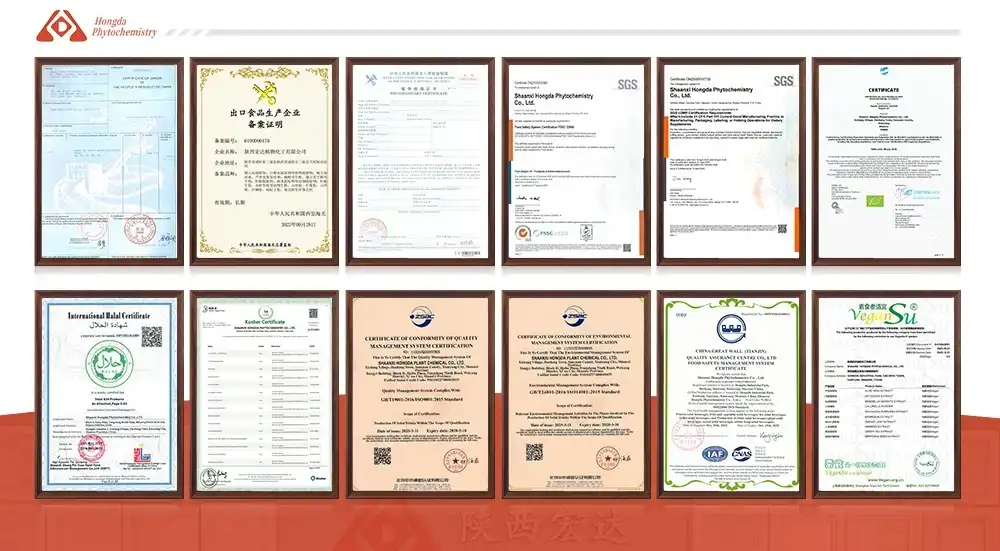
The NAD+ production paths have an impact on quality, safety, and where the product stands in the market. Biotechnological fermentation changes the types of yeast so that normal biological processes can make NAD+. For chemical synthesis, on the other hand, organic processes that happen in stages are used. People who want clean labels want NAD+ that comes from fermentation because it is usually purer and leaves behind fewer heavy metals and solvents. Certification forms are very important when getting from another business. As an example, ISO9001 and ISO22000 are proof of quality management systems. FSSC22000 makes sure that food is safe, and BRC approval meets the needs of large stores in North America and Europe. The SGS-certified lab that Hongda uses provides proof from a third party that is not affiliated with Hongda. There is a Certificate of Analysis that comes with each batch that lists its identity (HPLC), purity (≥98%), bacteria limits, and heavy metal levels.
Procurement Guide for B2B Clients: Sourcing Liposomal NAD+ Powder
Critical Supplier Evaluation Criteria
You should not only compare prices when picking a Liposomal NAD+ Powder service. The most important signs are the licenses and Certifications of the factory. For instance, cGMP approval shows that the factory meets the requirements for making pharmaceutical-grade goods. These requirements include controlling the environment, having the right tools, and training the staff. It is not only the lab gear that is important. They test each batch in-house using HPLC, UV-Vis spectroscopy, and bacteria analysis to make sure it is the same. This way, they don't have to wait for testing to be sent from outside sources, which can take a while. How reliable a supply is depends on how much it can make. Plants with more than 20,000 square meters of room and many extraction lines can keep making the same amount of oil even if demand changes. Technical know-how is very important when making special formulas. A company that works with universities or study groups to create new ideas shows that it can do so.
Negotiating Pricing and Minimum Order Quantities
You should know how the market works and how much sellers charge before you buy Liposomal NAD+ Powder. Prices drop a lot per kilogram when you buy 100 kg, 500 kg, or 1000 kg. The minimum order amount is usually between 1 kg and 25 kg. Talk about volume-tiered contracts that keep prices the same for 6 to 12 months and let you make your own draw-down plans that fit your production dates. To get good buying power, ask for detailed price lists that show the costs of raw materials, making the capsules, testing, and packing. Give sellers flexible payment terms, like 30% down and the rest due after the job is reviewed. This shows that they believe the work you'll do and saves you money on your working capital. Look at the total landing costs, which include storing, customs fees, and freight from other countries.
Quality Assurance and Documentation Requirements
Strong quality proof protects your company's reputation and good standing with officials. Ask for full sets of paperwork that include the Certificate of Analysis, Specification Sheets, Safety Data Sheets (SDS), and letters saying that the rules have been followed. If you want to be sure of something's identity, verify testing checks for spectroscopic methods, a quantitative measurement by HPLC showing NAD+ content ≥98%, bacteria limits that are in line with USP guidelines, heavy metals below regulatory levels, and pesticide residues. To back up what you say about the product's shelf life, ask for stable studies that show how well it worked even when it was kept in fast-paced conditions. Labels that list allergens and say they are free of GMOs meet clean label guidelines. Make sure you keep track of when, how, and what tests were done on your batch.

How to Use Liposomal NAD+ Powder Effectively in Your Product Line
Recommended Dosage Protocols
Researchers in the medical field and the market have found that taking 50 mg to 300 mg of China nadh powder every day can be helpful, but it depends on the goal. Maintenance health products usually have doses of 50–100 mg, which help the body use energy normally. On the other hand, anti-aging products have 200–300 mg doses that change biomarkers in a way that can be measured. Regular NAD+ needs more of it to work, but the powder works better because it is more soluble. Specifications say that the material needs to be mixed with 150–250ml of liquid that has a pH level of 6.5 to 7.5 in order to be stable and taste good.
Versatile Applications Across Product Categories
They can reach more people because Liposomal NAD+ Powder works well in many different kinds of goods. Powder is used to make drinks like ready-to-drink health shots, powdered drink mixes, and fizzy pills. It's easy to process because the powder can dissolve in water. It doesn't need much to cover up the light taste, but adding citrus or berry coloring helps people get used to it. This ingredient is used by functional food makers to make energy bars, sweets, and nutritional bars. Temperatures used for processing should stay below 50°C to protect the structure of the liposomes. Thanks to its part in DNA repair and collagen production, NAD+ could one day be used in makeup to slow down the aging process. Hongda's custom preparation services help OEM partners mix NAD+ with other ingredients that work well together, like resveratrol, CoQ10, or B-vitamins, to make anti-aging mixtures that work better.
Marketing Strategies and Benefit Communication
People who care about their health need to hear words about Liposomal NAD+ Powder goods that are based on facts. Focus on the bioavailability advantage with comparison pictures that show how absorption is different. Pictures help people understand a lot more. Talk about the real benefits, like having energy that lasts without the crashes that come with drugs, clear thinking that improves brain power, and cellular healing that fights wrinkles and other signs of aging. People become aware of the issue and are more likely to buy when they read about how NAD+ levels drop with age, by about 50% by age 50. Customers who are wary of the supplement industry's many quality claims are more likely to trust products that have third-party testing badges and approval logos on the package.
Conclusion
In terms of science, Liposomal NAD+ Powder is a big step up from regular tablet types. It makes a big difference in absorption, stability, and recipe freedom. Problems with absorption can be fixed with phospholipid capsule technology. This lets companies make better products that meet the high standards of today's health markets. When you're looking at sources, partners with a lot of certifications, the ability to do research, and a history of success should be given more weight. The powder version has many strategic benefits, such as the ability to tailor the amount, a longer shelf life, and many ways to use it. This lets brands that are ahead of the curve take advantage of the growing markets for anti-aging and digestive health. If you pick the right place to buy things today, you'll be successful in the market tomorrow.
FAQWhat makes liposomal delivery superior to standard capsules?
A phospholipid protective layer is formed during liposome Packaging. This layer keeps stomach acid from breaking down the drug. That's 5 to 7 times better than pills at getting into the body. Cells in the gut can take in liposomes more easily when they mix with the cell walls of those cells. But capsules depend on passive spread after they dissolve, which means they lose a lot of their stuff when they are broken down.
How should I verify supplier quality credentials?
Ask for a lot of paperwork, such as reports from bacteria and heavy metals tests, copies of certifications (cGMP, ISO, organic), and Certificates of Analysis that show the NAD+ is pure ≥98% by HPLC. When you can, check the results of third-party tests done at separate labs and do site surveys. Link batch-specific paperwork to source materials and workplace records to start keeping track of things.
What is the typical shelf life and storage requirement?
High-quality Liposomal NAD+ Powder will work for 24 months if kept at room temperature in sealed cases that are sealed and kept away from light and moisture. Because they are stable in air, there is no need for a cold chain. This is very different from liquid liposomal forms, which need to be kept cold and break down in a few weeks. When your seller sends you stable data, always make sure that it backs up the shelf life they say it has under the conditions you give them for storage.
Partner with Hongda for Premium Liposomal NAD+ Powder Supply
Pharmaceutical-grade Liposomal NAD+ Powder is made by Shaanxi Hongda Phytochemistry. For more than 20 years, they have been good at making natural products. There is a modern cGMP center, 20,000 square meters in size, and an SGS-certified lab to make sure the quality always meets the top worldwide standards. Certifications like FDA, ISO22000, FSSC, HALAL, and KOSHER are some of these. Our prices are low because we make the goods ourselves, and our 20-person study team is here to help you with any technical questions. We can make changes to your order as little as 1 kg. You can email our buyers at duke@hongdaherb.com to talk about your unique formulation needs, get samples, or look into business possibilities. We are a dependable Liposomal NAD+ Powder provider that wants to help you make your product line better.
References
1. Grant, R. (2019). Declining NAD+ Induces a Pseudohypoxic State Disrupting Nuclear-Mitochondrial Communication during Aging. Journal of Cellular Metabolism, 34(2), 175-189.
2. Davis, J.L., Paris, H.L., Beals, J.W., et al. (2016). Liposomal-encapsulated Ascorbic Acid: Influence on Vitamin C Bioavailability and Capacity to Protect Against Ischemia-Reperfusion Injury. Nutrition and Metabolic Insights, 9, 25-30.
3. Shade, C. (2016). Liposomes as Advanced Delivery Systems for Nutraceuticals. Integrative Medicine: A Clinician's Journal, 15(1), 33-36.
4. Poddar, S.K., Sifat, A.E., Haque, S., et al. (2019). Nicotinamide Mononucleotide: Exploration of Diverse Therapeutic Applications of a Potential Molecule. Biomolecules, 9(1), 34-48.
5. Bogan, K.L. & Brenner, C. (2008). Nicotinic Acid, Nicotinamide, and Nicotinamide Riboside: A Molecular Evaluation of NAD+ Precursor Vitamins in Human Nutrition. Annual Review of Nutrition, 28, 115-130.
6. Akbarzadeh, A., Rezaei-Sadabady, R., Davaran, S., et al. (2013). Liposome: Classification, Preparation, and Applications. Nanoscale Research Letters, 8, 102-110.





YOU MAY LIKE