



What Should Buyers Verify Before Sourcing Liposomal Coenzyme Q10 Powder in Bulk?
2026-11-13 15:53:30
Ask a formulator why CoQ10 is so tough, and the response is generally the same: the molecule is great but recalcitrant. Co Q10 is the key to cellular energy generation, yet it is fat-soluble, waxy, and hard to absorb. That's where liposomal coenzyme q10 powder comes into the picture, encapsulating the vitamin in phospholipid vesicles and drying it to a powder that dissolves in water. In this post, we’ll take you through, step by step, what makes the liposomal method more successful, how Hongda’s version is produced, where it fits in actual goods, and how to check the claims before you purchase.
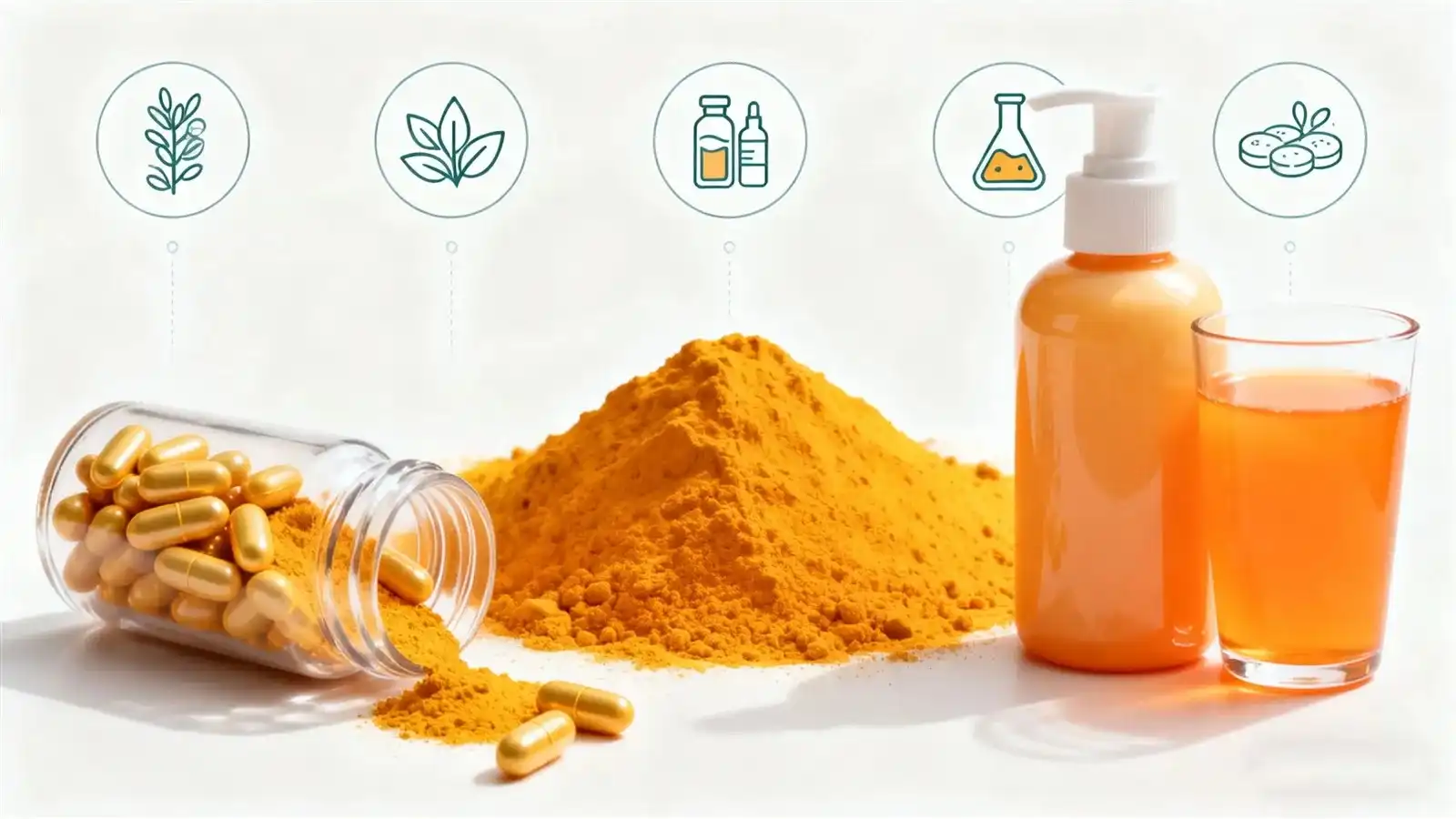
The Bioavailability Puzzle: Why Ordinary CoQ10 Falls Short
A Fat-Loving Molecule in a Water-Based Body
Coenzyme Q10 is present in almost every cell and is created in the body. It helps shuttle electrons during the process of creating energy, but it also works as an antioxidant in cell membranes. The popularity of supplementation grew, since it is thought that natural levels fall as people age. The problem is chemistry. CoQ10 is very lipophilic, which means that it dissolves hardly at all in the aqueous environment of the digestive system. Its absorption (Bhagavan and Chopra, 2006) has been reviewed and shown to be sluggish and restricted, and dependent upon dietary fat and formulation. That’s the issue that a good liposomal coenzyme Q10 powder maker is trying to tackle. Instead of expecting a waxy crystal to make its own way through the stomach, the producer coats it with phospholipids, which behave naturally in water. This problem helps you make the decision if a liposomal coenzyme Q10 powder is worth the premium it fetches.
Why Dispersion Decides Everything
Not all CoQ10 products are equal, and frequently the difference is not obvious on the label. In a 2020 review in Antioxidants, Mantle and Dybring followed CoQ10 through the stomach, the intestine, the lymphatic system, and the bloodstream, emphasizing that formulation is a major factor. The abstract notes that failure to disperse the crystals can reduce bioavailability by roughly 75%. Previous studies of commercial items have likewise shown considerable variances across products (e.g., Weis and colleagues 1994). This implies that two tubs with the same milligram value might work significantly differently in the body. A good liposomal coenzyme Q10 powder maker knows that dispersion is the first quality aim, and a good liposomal coenzyme Q10 powder will illustrate it with quantitative particle size, polydispersity, and encapsulation statistics, not marketing jargon.
Where Liposomes Step In
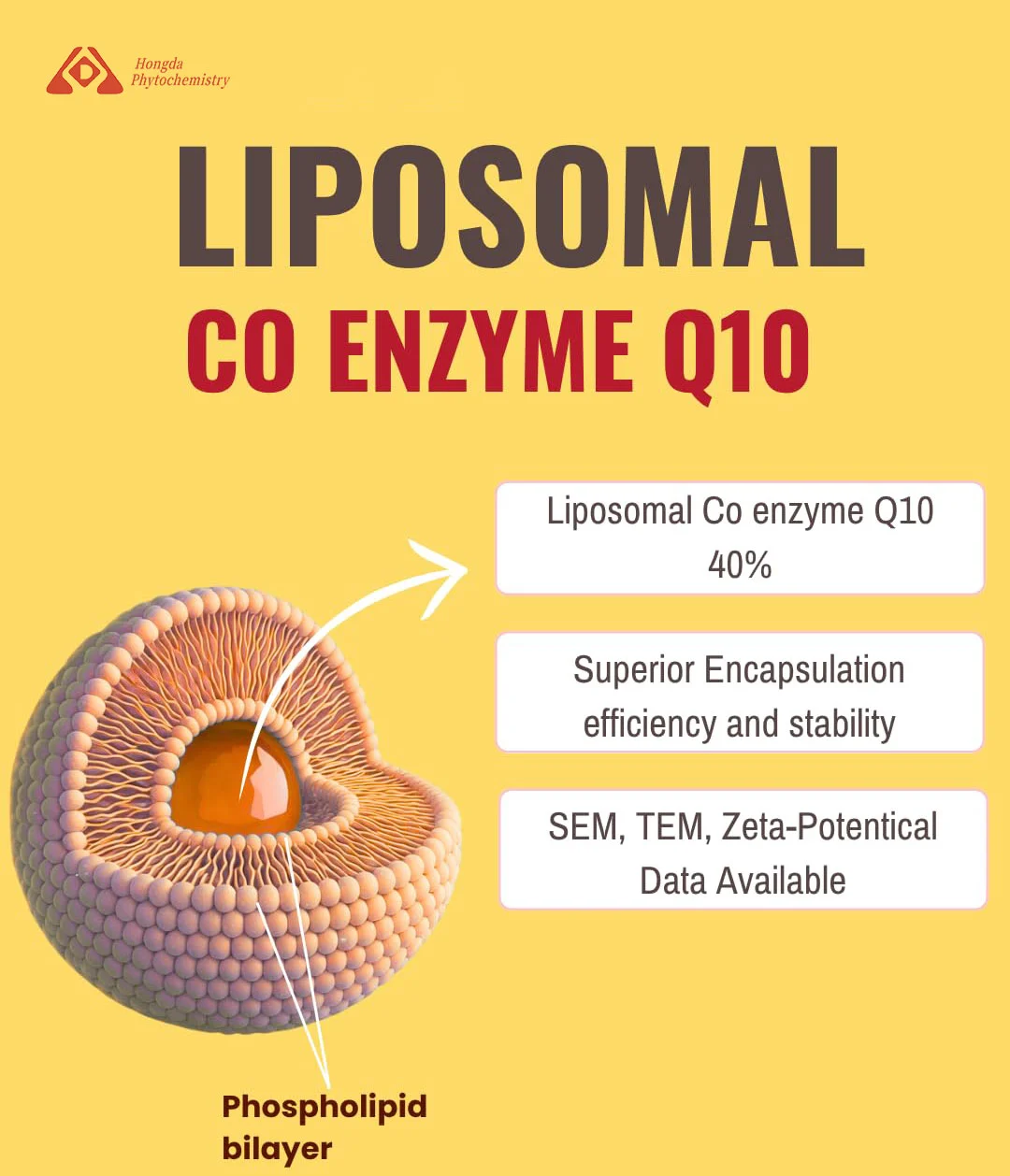
Liposomes are tiny spheres composed of phospholipid bilayers, the very same substance cell membranes are made of, and have been investigated for decades as transporters of poorly soluble chemicals. The bilayer wraps around the chemical, keeps it disseminated in water, and delivers it to the stomach in a form meant to be absorbed more readily. Hongda says their liposomal coenzyme Q10 powder is 300 to 500 percent more bioavailable than regular CoQ10. This is a supplier-stated statistic that is worth checking out in your own experiments, as the site doesn’t mention research. Any credible producer of liposomal coenzyme Q10 powder will tell you what is documented and what is positioning. In the comparison below, regular CoQ10 is contrasted with the liposomal method so you can understand where the benefits are physical, practical, or still to be established.
Table 1. Conventional CoQ10 vs. Hongda Liposomal Coenzyme Q10 Powder
| Feature | Conventional CoQ10 | Hongda Liposomal Coenzyme Q10 Powder |
|---|---|---|
| Physical nature | Lipophilic crystalline material, poorly water-dispersible | Phospholipid-wrapped vesicles |
| Dispersion | Depends heavily on how well crystals are dispersed in the carrier | Disperses in cold water as a nano-emulsion without added emulsifiers |
| Absorption | Limited and formulation-dependent | Stated 300–500% higher bioavailability (supplier-stated) |
| Handling | Often supplied in oil-based formats | Free-flowing powder for capsules, sachets, and drink mixes |
| Cold chain | Varies | Not required (stated) |
Sources: Hongda Phytochemistry liposomal coenzyme q10 powder manufacturer product page; Mantle and Dybring, Antioxidants, 2020; Bhagavan and Chopra, Free Radical Research, 2006.

Inside Hongda's Liposomal Coenzyme Q10 Powder: The Design Choices That Matter
Sunflower Lecithin Bilayers, No Synthetic Surfactants
The initial design decision is the carrier. Hongda’s liposomal coenzyme Q10 powder is based on non-GMO sunflower lecithin, and the product website indicates that it contains no synthetic surfactants or polysorbate 80. This matters for firms pursuing clean labels, since buyers are increasingly scanning ingredient lists for strange chemistry. The nutrient itself is ubiquinone, with a defined content of 70% +/- 5% and a reported HPLC result of 73.1%. Production: thin film hydration, extrusion or high-pressure homogenization, spray drying, quality-controlled release. A good liposomal coenzyme Q10 powder producer describes each stage in simple terms, since any process that is easy to define is typically straightforward to govern. When reviewing bids, select the liposomal coenzyme Q10 powder if the carrier, composition, and procedure are all well defined.
Vesicle Size, Zeta Potential, and Encapsulation
There are three values that tell you whether liposomes are performing their job. The uniformity of the particles is shown in the vesicle size reported below 200 nanometers with a polydispersity index below 0.3. The encapsulation efficiency, claimed to be more than 85%, tells us how much CoQ10 is really within the shells. The zeta potential was between minus 20 and minus 45 millivolts, showing how much the particles repel each other and remain scattered. The powder, Hongda claims, will disperse in cold water to form a nano-emulsion without the need for emulsifiers. A liposomal coenzyme Q10 powder is only as excellent as its batch data. Get dynamic light scattering and encapsulation reports from your liposomal coenzyme Q10 powder manufacturer for the precise lot number you will be receiving. These design parameters are summarized in the table below.
Table 2. Design Parameters of Hongda Liposomal Coenzyme Q10 Powder
| Parameter | Specification |
|---|---|
| Active ingredient | Ubiquinone (CoQ10) |
| CoQ10 content | 70% ± 5% (result: 73.1%, HPLC) |
| Carrier | Non-GMO sunflower lecithin; no synthetic surfactants or polysorbate 80 |
| Vesicle size | Below 200 nm |
| Polydispersity index | Below 0.3 |
| Encapsulation efficiency | Above 85% |
| Zeta potential | −20 to −45 mV |
| Dispersion | Cold-water dispersible nano-emulsion |
| Form | Free-flowing powder |
Source: Hongda Phytochemistry liposomal coenzyme Q10 powder product page.
Spray-Dried Stability and No Cold Chain
Liquid liposomes may be sensitive; therefore, drying them into powder is a practical milestone. Hongda spray-dries their vesicles and reports a loss on drying of 1.2% against a limit of 5%. Shelf life is 24 months and storage is in unopened original vacuum packing below 25 degrees Celsius, away from light and moisture. The powder is resistant to oxidation and does not need a cold chain, which makes it simpler for distributors to distribute and store. An experienced maker of liposomal coenzyme Q10 powder will tell you that drying, packing, and storage all work together to safeguard the vesicles. If you want to examine the specifications and an example strategy for your own market, then write to duke@hongdaherb.com and the Hongda team will respond with details on liposomal coenzyme Q10 powder grades, pack sizes, and trial options.
Putting the Advantage to Work in Real FormulasFunctional Beverages and Ready-to-Mix Powders
Oil-based CoQ10 can’t accomplish what water dispersibility does. Among Hongda’s key uses are functional drinks and ready-to-mix powders, and the cold-water nano-emulsion behavior is suitable for stick packs, wellness shots, and fast drink mixes. Test your own acids, sugars, and tastes in bench trials and track appearance and settling over time. Beverage circumstances might be very different from a clean water test. A hands-on liposomal coenzyme Q10 powder maker will provide application comments and may propose beginning pH ranges. Beverages also provide businesses an opportunity to create a new story: energy support in a manner that seems contemporary, not medical. If a liposomal coenzyme Q10 powder blends well and tastes neutral, repeat purchase is likely to follow, and it is repeat purchase that is the true test of any new product in a congested functional-drink market.
Capsules, Sachets, and Nutricosmetic Blends
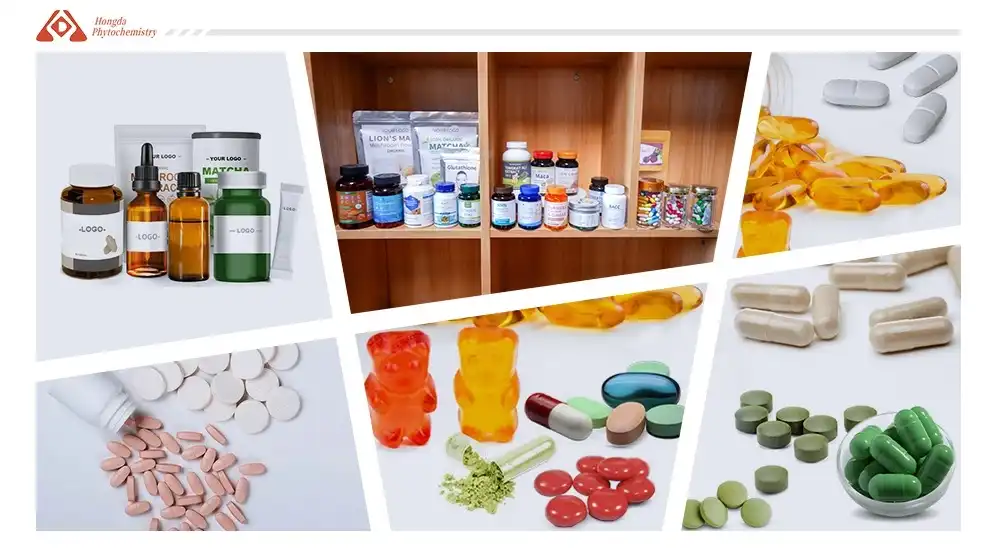
Alongside beverages, the product site also has hard capsules, sachets, and nutricosmetic blends, the beauty-from-within products that combine nutrients with skin-friendly elements. Capsules safeguard the powder and make dosing straightforward, while sachets are great for travel and single-serve regimens. One practical note: the website suggests care with tablets, as excessive compression might harm liposomal vesicles, so companies that want a tablet should discuss mild processing with the team beforehand. Ask your liposomal coenzyme q10 powder manufacturer for bulk density estimates. Hongda reports 600 grams per liter loose and 918 grams per liter tapped, so engineers can arrange filling equipment. A well-chosen liposomal coenzyme Q10 powder conforms to these formats since it flows readily and behaves consistently on automated lines, saving time in scale-up.
Smart Pairings with Vitamins, and Adaptogens
Single-ingredient energy products are simple to replicate; therefore, many manufacturers construct mixtures. Hongda OEM team provides unique CoQ10 concentrations and mixes with B vitamins, and adaptogens. They have a research team of 20+ professionals. Ask your liposomal coenzyme Q10 powder producer to do compatibility testing and provide stability data for any combination before introducing it to the market. Keep the explanation basic enough for a label. A well-thought-out liposomal coenzyme Q10 powder mix provides you a point of distinction, and sample size trials from 1 kg allow you to trial numerous ideas without committing to huge quantities too early.

Choosing a Partner Who Can Prove It
Batch Testing and the Documents That Back the Claims
Effectiveness claims are only as strong as the paperwork behind them. Hongda describes in-house testing for HPLC assay, particle size, zeta potential, heavy metals, microbiology, and moisture, with third-party verification by SGS and Eurofins, and says each batch can come with a certificate of analysis, a safety data sheet, a heavy metal report, a pesticide residue report, and a third-party report. The specification lists loss on drying of 1.2%, heavy metals not detected, and a total microbial count of 50 cfu per gram. Ask any liposomal coenzyme Q10 powder manufacturer for the same package, and insist it matches the lot you receive. A trustworthy supplier of liposomal coenzyme Q10 powder will never hesitate. The table below summarizes the quality data.
Table 3. Quality Data and Batch Documents for Hongda Liposomal Coenzyme Q10 Powder
|
ITEM
|
SPECIFICATION
|
RESULTS
|
|
Assay(CoQ10)
|
70%士5%
|
73.1%
|
|
Appearance
|
Of-white to light yellow Powder
|
Conforms
|
|
Physical& Chemical Characteristics
|
||
|
Particle size(20Mesh)
|
90%
|
Conforms
|
|
Lose on dyring
|
≤5.0%
|
1.2%
|
|
Bulk Density
|
Actual Value
|
600g/L
|
|
Tapped Bulk Density
|
Actual Value
|
918g/L
|
|
Heavy metals
|
||
|
ead(Pb)
|
≤0.5ppm
|
Not Detected
|
|
Arsenic(As)
|
≤2.0ppm
|
Not Detected
|
|
Mercury(Hg)
|
≤0.3ppm
|
Not Detected
|
|
Cadmium(Cd)
|
≤0.3ppm
|
Not Detected
|
|
Microbiological Tests
|
||
|
Total Microbial Count
|
≤10000cfu/g
|
50cfu/g
|
|
Coliforms
|
<10MPN/g
|
0.310MPN/g
|
|
Conclusion:
|
Conform to In-house standard.
|
|
Source: Hongda Phytochemistry liposomal coenzyme Q10 powder product page.
Certifications, Scale, and R&D Strength
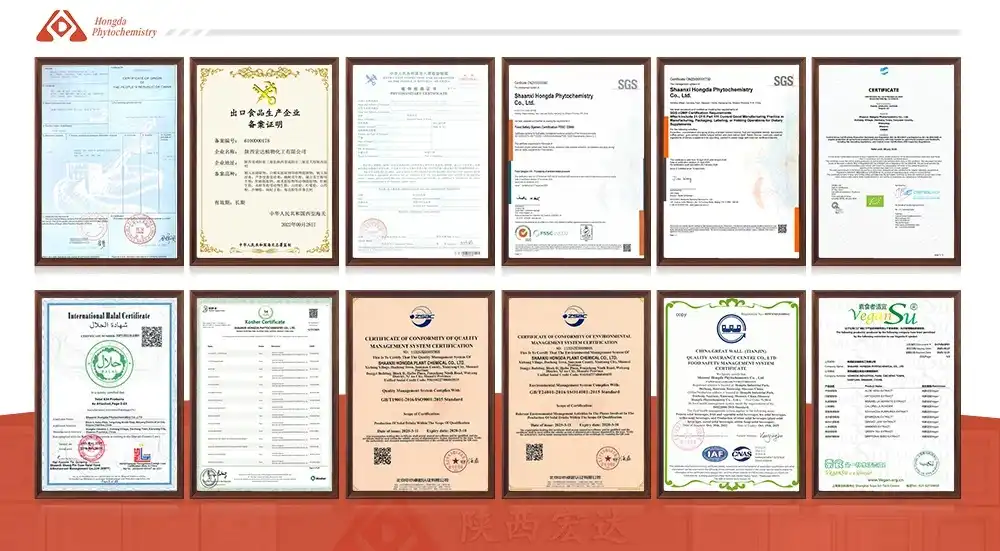
Hongda was created in 2001. It has a plant of 20,000 square meters, a 100,000-level purification workshop, an annual capacity of 3,000 tons, and an in-house laboratory equipped with HPLC, GC, UV, and atomic absorption. The product has the following specified credentials: cGMP, FSSC22000, ISO9001, ISO22000, HALAL, KOSHER, FDA, and organic (EU and NOP). It also has a vegan listing, which should be confirmed with the batch documentation for the buyer’s market. This information will tell you if the liposomal coenzyme Q10 powder manufacturer has control over the whole manufacturing process from start to finish. Get copies of the certificates. Check the site against each one. Ask for an audit. In a factory, you may have actual labs and qualified R&D staff that can adapt liposomal coenzyme q10 powder to new forms. This is a crucial benefit when your product variety grows.
Samples, OEM Options, and Packaging
“Start small, and you lower your risk. Hongda can provide sample and R&D validation from 1 kg, asked directly via its sales email. Hongda can provide custom label and private-label Packaging in aluminum foil bags and fiber barrels. OEM services include unique concentrations and mixes, as well as completed forms such as capsules and sachets. When you reach out to a producer of liposomal coenzyme Q10 powder, provide your intended format, market, and launch date in the initial communication, so that the reply may be tailored. Check the content, vesicle size, shelf life, and storage conditions in a signed specification. Test a trial batch in your own base and compare findings with the supplier's data. Brands that do this process discover a strong liposomal coenzyme Q10 powder collaboration feels like having an additional R&D department.
Conclusion
A series of design decisions makes liposomal coenzyme q10 powder more effective: sunflower lecithin bilayers spread a fat-soluble nutrient in water, homogeneous vesicles with excellent encapsulation, and spray-dried stability requiring no cold chain. Effectiveness is not guaranteed; ask for batch reports and test samples yourself. Shaanxi Hongda has been in the plant extract industry since 2001, has cGMP production with an SGS-accredited laboratory, is open to customisation, and answers queries 24/7. We have over 400 products, and not everything is posted on our website. If you can't locate what you need, Contact Us at duke@hongdaherb.com.
FAQ1. What is liposomal coenzyme Q10 powder?
It is CoQ10 (ubiquinone) enclosed in sunflower lecithin vesicles and spray-dried into a water-dispersible powder.
2. Why is the liposomal form considered more effective?
Phospholipid vesicles help the fat-soluble nutrient disperse in water, which is designed to support better absorption.
3. What CoQ10 content does Hongda list?
The specification is 70% plus or minus 5%, with a reported HPLC result of 73.1%.
4. Which formats suit this powder?
Functional beverages, ready-to-mix powders, hard capsules, sachets, and nutricosmetic blends; tablets need careful processing.
5. Can I request a sample?
Yes. Hongda supports sampling and R&D validation from 1 kg through its sales email.
Boost Your CoQ10 Range with Hongda Liposomal Coenzyme Q10 Powder
You now understand what separates an effective CoQ10 from an ordinary one, so the next step is simple. Hongda Phytochemistry supplies liposomal coenzyme q10 powder with documented specifications, SGS and Eurofins batch verification, cGMP production, and a customer team available around the clock. Whether you need a 1 kg sample, a custom concentration, a blend with B vitamins, or private-label packaging, we will build it around your market. Email duke@hongdaherb.com today to request specifications, a certificate of analysis, a quotation, and a delivery plan, and let Hongda help you launch a CoQ10 product your customers will trust and reorder.
References
1. Mantle D, Dybring A. Bioavailability of coenzyme Q10: an overview of the absorption process and subsequent metabolism. Antioxidants. 2020;9(5):386.
2. Bhagavan HN, Chopra RK. Coenzyme Q10: absorption, tissue uptake, metabolism and pharmacokinetics. Free Radical Research. 2006;40(5):445–453.
3. Arenas-Jal M, Suñé-Negre JM, García-Montoya E. Coenzyme Q10 supplementation: efficacy, safety, and formulation challenges. Comprehensive Reviews in Food Science and Food Safety. 2020;19(2):574–594.
4. Hernández-Camacho JD, Bernier M, López-Lluch G, Navas P. Coenzyme Q10 supplementation in aging and disease. Frontiers in Physiology. 2018;9:44.
5. Weis M, Mortensen SA, Rassing MR, Møller-Sonnergaard J, Poulsen G, Rasmussen SN. Bioavailability of four oral coenzyme Q10 formulations in healthy volunteers. Molecular Aspects of Medicine. 1994;15(Suppl):s273–s280.
6. Akbarzadeh A, Rezaei-Sadabady R, Davaran S, et al. Liposome: classification, preparation, and applications. Nanoscale Research Letters. 2013;8(1):102.





YOU MAY LIKE
