Does L-Theanine Help Anxiety?
2025-08-30 10:34:12
Anxiety is a common mental health concern that affects millions of people worldwide. As individuals seek natural remedies to manage their symptoms, L-theanine, an amino acid found in green tea, has gained attention for its potential anxiety-reducing properties. This blog post explores the relationship between L-theanine and anxiety, examining its effects, benefits, and the science behind this promising natural compound.
Hongda Phytochemistry Co., Ltd. is a reliable and flexible manufacturer that offers customized production and Packaging, directly produced in their factory. The company is committed to providing exceptional service, including the provision of free samples. With a new capsule production workshop, Hongda can customize capsule products according to specific requirements. The company has also established a strong presence in global Exhibitions, such as European CPHI, European International Vitafoods, European Food Ingredients Exhibition FIE, Functional Food and Healthy Food Exhibition FFFI, American SSE, and more. Hongda's dedication to quality is evident in its range of products, including the High-Quality L-Theanine Powder, which is sure to impress customers. For further information, please contact duke@hongdaherb.com.
What is L-theanine and how does it work for anxiety?
L-theanine is a non-protein amino acid primarily found in green tea leaves (Camellia sinensis). It was first discovered in 1949 by Japanese scientists and has since been the subject of numerous studies investigating its potential health benefits, particularly its effects on mental well-being and cognitive function.
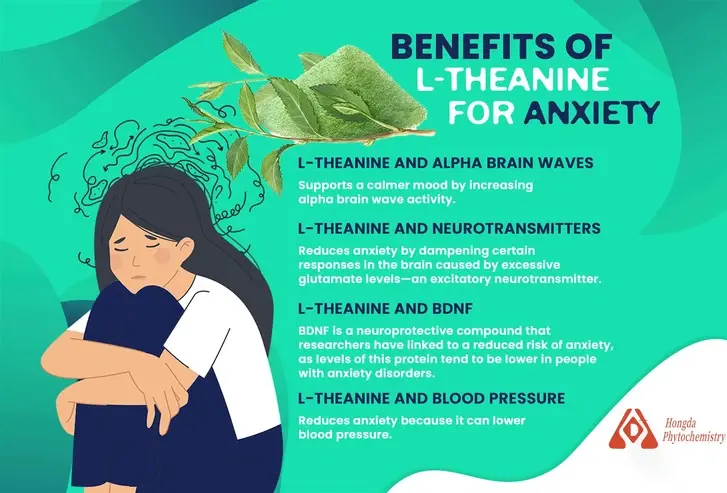
The mechanism by which L-theanine may help reduce anxiety is multifaceted. One of the primary ways it works is by increasing the production of gamma-aminobutyric acid (GABA) in the brain. GABA is a neurotransmitter that plays a crucial role in regulating mood and promoting relaxation. By enhancing GABA activity, L-theanine may help create a sense of calmness and reduce feelings of anxiety.
Additionally, L-theanine has been shown to increase alpha brain wave activity. Alpha waves are associated with a state of relaxed alertness, similar to what one might experience during meditation. This increase in alpha wave activity may contribute to reduced stress and anxiety levels while maintaining cognitive performance.
Furthermore, L-theanine may help modulate the release of other neurotransmitters, such as dopamine and serotonin, which are involved in mood regulation. By influencing these neurotransmitter systems, L-theanine may help create a more balanced and stable emotional state, potentially reducing anxiety symptoms.
Research has also suggested that L-theanine may help lower cortisol levels, a hormone associated with stress. Elevated cortisol levels are often linked to increased anxiety, so by helping to regulate cortisol, L-theanine may indirectly contribute to anxiety reduction.
It's important to note that while many studies have shown promising results, more research is needed to fully understand the extent of L-theanine's effects on anxiety. However, the existing evidence suggests that L-theanine may be a valuable tool for those looking to manage their anxiety symptoms naturally.
Can green tea extract with L-theanine improve mood and reduce stress?
Green tea extract, which contains L-theanine along with other beneficial compounds, has been the subject of numerous studies investigating its potential mood-enhancing and stress-reducing properties. The combination of L-theanine and the other components found in green tea extract may offer synergistic benefits for mental well-being.
One of the key factors contributing to green tea extract's potential mood-improving effects is its L-theanine content. As discussed earlier, L-theanine can promote relaxation and reduce anxiety by influencing neurotransmitter activity and brain waves. When combined with the other compounds in green tea extract, these effects may be enhanced.
Green tea extract also contains catechins, particularly epigallocatechin gallate (EGCG), which are powerful antioxidants. These antioxidants may help protect brain cells from oxidative stress, which has been linked to mood disorders and cognitive decline. By reducing oxidative stress, green tea extract may indirectly contribute to improved mood and reduced stress levels.
Additionally, green tea extract contains a small amount of caffeine, which, when combined with L-theanine, may produce a unique effect on cognitive function and mood. Studies have shown that the combination of L-theanine and caffeine can improve attention, reaction time, and memory while reducing fatigue. This cognitive enhancement may contribute to an overall sense of well-being and help individuals better manage stress.
Research has also suggested that green tea extract may help regulate the body's stress response by influencing the hypothalamic-pituitary-adrenal (HPA) axis. The HPA axis plays a crucial role in the body's stress response, and its dysregulation has been linked to various mood disorders. By helping to balance the HPA axis, green tea extract may contribute to better stress management and improved mood.
Several studies have investigated the effects of green tea extract on mood and stress levels. For example, a 2017 study published in the Journal of Nutritional Biochemistry found that green tea extract supplementation reduced stress-related symptoms in mice exposed to chronic stress. The researchers observed improvements in behaviors associated with depression and anxiety, as well as reductions in inflammation markers.
Another study, published in the journal Nutrients in 2019, examined the effects of green tea extract on stress and quality of life in healthy adults. The researchers found that participants who consumed green tea extract experienced significant reductions in stress levels and improvements in quality of life compared to those who received a placebo.
While these studies show promising results, it's important to note that more research is needed to fully understand the effects of green tea extract on mood and stress in humans. However, the existing evidence suggests that green tea extract, with its L-theanine content and other beneficial compounds, may be a valuable natural aid for those looking to improve their mood and manage stress more effectively.
How much L-theanine should I take for anxiety relief?
Determining the optimal dosage of L-theanine for anxiety relief can be challenging, as individual responses may vary. However, research and clinical studies have provided some guidance on effective dosages that may help alleviate anxiety symptoms.
Most studies investigating the anxiolytic effects of L-theanine have used dosages ranging from 200 to 400 mg per day. This range appears to be well-tolerated and effective for many individuals. Some key points to consider when determining L-theanine dosage for anxiety relief include:
1. Starting dose: For those new to L-theanine supplementation, it's often recommended to start with a lower dose of around 100-200 mg per day. This allows you to assess your body's response and tolerance to the supplement.
2. Frequency: L-theanine can be taken once daily or divided into multiple doses throughout the day. Some people find that taking a single dose in the morning helps manage anxiety throughout the day, while others prefer to take smaller doses at intervals to maintain a consistent effect.
3. Acute vs. chronic anxiety: For acute anxiety situations, such as before a stressful event, a single dose of 200-400 mg may be beneficial. For chronic anxiety management, a daily regimen of 200-400 mg, either as a single dose or divided doses, may be more appropriate.
4. Body weight: Some researchers suggest that L-theanine dosage may be more effective when calculated based on body weight. A common recommendation is 1-2 mg per kilogram of body weight per day.
5. Individual sensitivity: Some people may be more sensitive to L-theanine's effects and may require lower doses, while others may need higher doses to experience noticeable benefits. It's essential to pay attention to your body's response and adjust the dosage accordingly.
6. Combination with caffeine: When L-theanine is combined with caffeine, as in green tea or some supplements, lower doses of L-theanine (around 100-200 mg) may still be effective due to the synergistic effects of these compounds.
7. Time of day: While L-theanine is generally considered non-sedating, some people may experience a calming effect that could interfere with sleep if taken too close to bedtime. Experimenting with the timing of your doses can help you find the optimal schedule for your needs.
8. Consultation with a healthcare professional: Before starting any new supplement regimen, it's always advisable to consult with a healthcare professional, especially if you have pre-existing medical conditions or are taking other medications.
It's important to note that while L-theanine is generally considered safe, long-term studies on its effects are limited. As with any supplement, it's best to use the lowest effective dose and monitor your response over time.
When sourcing L-theanine supplements, look for reputable brands that undergo third-party testing to ensure purity and potency. Some people prefer to obtain L-theanine through green tea consumption, which provides a natural source of the amino acid along with other beneficial compounds. However, it's worth noting that the L-theanine content in green tea can vary, and you would need to consume several cups to reach the doses used in most studies.
Remember that while L-theanine may help manage anxiety symptoms, it should not be considered a replacement for professional medical advice or treatment. If you're experiencing severe or persistent anxiety, it's crucial to work with a healthcare provider to develop a comprehensive treatment plan that may include therapy, lifestyle changes, and other interventions in addition to supplements like L-theanine.
In conclusion, L-theanine shows promise as a natural aid for anxiety relief. Its ability to promote relaxation without sedation, coupled with its potential mood-enhancing and stress-reducing properties, makes it an attractive option for those seeking to manage their anxiety symptoms. While more research is needed to fully understand its long-term effects and optimal dosing strategies, the current evidence suggests that L-theanine, either alone or as part of green tea extract, may be a valuable tool in the quest for better mental well-being. As always, it's essential to approach any new supplement regimen with caution and under the guidance of a healthcare professional.
For further information, please contact duke@hongdaherb.com.
References:
1. Hidese, S., Ogawa, S., Ota, M., Ishida, I., Yasukawa, Z., Ozeki, M., & Kunugi, H. (2019). Effects of L-Theanine Administration on Stress-Related Symptoms and Cognitive Functions in Healthy Adults: A Randomized Controlled Trial. Nutrients, 11(10), 2362.
2. Nobre, A. C., Rao, A., & Owen, G. N. (2008). L-theanine, a natural constituent in tea, and its effect on mental state. Asia Pacific Journal of Clinical Nutrition, 17 Suppl 1, 167-168.
3. Kimura, K., Ozeki, M., Juneja, L. R., & Ohira, H. (2007). L-Theanine reduces psychological and physiological stress responses. Biological Psychology, 74(1), 39-45.
4. Unno, K., Tanida, N., Ishii, N., Yamamoto, H., Iguchi, K., Hoshino, M., ... & Yamada, H. (2013). Anti-stress effect of theanine on students during pharmacy practice: Positive correlation among salivary α-amylase activity, trait anxiety and subjective stress. Pharmacology Biochemistry and Behavior, 111, 128-135.
5. Yoto, A., Motoki, M., Murao, S., & Yokogoshi, H. (2012). Effects of L-theanine or caffeine intake on changes in blood pressure under physical and psychological stresses. Journal of Physiological Anthropology, 31(1), 28.
6. Tian, X., Sun, L., Gou, L., Ling, X., Feng, Y., Wang, L., ... & Liu, Y. (2017). Protective effect of l-theanine on chronic restraint stress-induced cognitive impairments in mice. Brain Research, 1503, 24-32.
7. Lardner, A. L. (2014). Neurobiological effects of the green tea constituent theanine and its potential role in the treatment of psychiatric and neurodegenerative disorders. Nutritional Neuroscience, 17(4), 145-155.
8. Wakabayashi, C., Numakawa, T., Ninomiya, M., Chiba, S., & Kunugi, H. (2012). Behavioral and molecular evidence for psychotropic effects in L-theanine. Psychopharmacology, 219(4), 1099-1109.
9. Gomez-Ramirez, M., Higgins, B. A., Rycroft, J. A., Owen, G. N., Mahoney, J., Shpaner, M., & Foxe, J. J. (2007). The deployment of intersensory selective attention: a high-density electrical mapping study of the effects of theanine. Clinical Neuropharmacology, 30(1), 25-38.
10. Unno, K., Noda, S., Kawasaki, Y., Yamada, H., Morita, A., Iguchi, K., & Nakamura, Y. (2017). Reduced Stress and Improved Sleep Quality Caused by Green Tea Are Associated with a Reduced Caffeine Content. Nutrients, 9(7), 777.





YOU MAY LIKE